
A Lover’s Pinch: A Cultural History of Sadomasochism

December 15th, 2018

Although there are many books about S&M, most of them focus on the erotic or instructional. This isn’t the case with A Lover’s Pinch: A Cultural History of Sadomasochism, a book by kinkster Peter Tupper. This means that A Lover’s Pinch fills a void, and it dives to depths I couldn’t have imagined before I started reading.

A Lover’s Pinch is a deep dive that goes far beyond Leopold von Sacher-Masoch the Marquis de Sade. Admittedly, I wasn’t expected to read analyses of how religion, war, and slavery impacted our sexualities (and relevant imagery is included on some pages), but the author of this book is not afraid to broach those subjects.

I wouldn’t say that tricky subjects aren’t handled with care within these pages or that it’s un-PC, but the tone is sometimes decidedly frank. If you’re especially religious or still experience trauma from war or slavery, then A Lover’s Pinch might not be a book you wish to pick up (or you may wish to skip those specific chapters).

With this in mind, the book starts with a strong historical tone. The author touche on worldwide (sometimes longstanding) stereotypes of sex and power including the Orient as well as Nazis (and the strange, erotic movies inspired by them).  It’s, thorough and interesting to learn but definitely dry and perhaps not applicable to modern kinksters.

I found that A Lover’s Pinch really picked up as Tupper dove into Victorian England’s relationship with sex, one that is similar to that in modern America: both obsessed and prudish. As he analyzes the (not-so) secret kink in this era, describes the lives of specific individuals and introduces the reader to publications that deal with S&M, you really get a feel for how long we’ve been into power exchange in our sex (and lives). Of course, these ongoings are generally fragmented, and there isn’t much to speak of in terms of community.

The reader watches the community come and build together in the 20th century, and this is where I think Tupper does the best at describing how things really were. Yes, some men returned from war, donned leather vests, and continued to live within the structure they’d grown to know in the service by practicing S&M with other men. But the author describes how, for some, the leather community was not one that was sexual.

As the book — and time — progresses, we learn how the kink community overlaps with the gay community and how, slowly but surely, gay women and, eventually, straight people join the S&M community. Tupper discusses some of the better-known groups from across the country and world, including DC’s Black Rose, Janus, and the many gay and lesbian communities that supported — and sometimes opposed — such activities.

I was especially struck by the way that the book describes how some feminists railed against S&M as something that was misogynistic. I learned of similar opposition from feminists to sex toys, especially dildos when I read Buzz.

Tupper’s analysis of gay, lesbian, and straight S&M is important, and he impresses upon the reader how these communities are still separated in ways — and even the division within the leather/gay S&M communities due to an entire generation succumbing to AIDS. If there is a more overarching theme of A Lover’s Pinch, I don’t know what it is. While many people are into S&M, and there are groups in many major cities, it’s still as fragmented as the Android market.

Still, S&M has followed a similar trajectory as homosexuality, first ignored and denied, then pathologized and illegalized, next slowly decriminalized, increasingly understand, and, to some extent, accepted. Tupper skillfully draws the parallel.

It was interesting to see the progression from haphazardly-created communities and risky scenes to planned organizations (and to learn the origin of munches) to the adoption of the “Safe, Sane, Consensual” creed, which was never intended to guide an entire sexual subculture. In some ways, BDSM became commodified alongside these other cultural shifts.

My favorite chapter in this book may have been that on “Alt.sex”. Although I am too young to have used Usenet, I remember the days of HTML-based chatrooms, which may have been my own introduction to BDSM. Tupper discusses the usefulness (and lack thereof) of capitalization conventions and how S&M relationships have existed solely in the online realm. He touches on Gor communities and online roleplaying. I remember many of these things fondly, and while they’re in relatively recent past when it comes to the overall history of S&M (as this book does a good job at pointing out), my own memories from 15-20 years ago seem so long ago.

As the book wraps up, Tupper reveals his own interest in S&M and coming out, and how coming out is different for kinksters than those in the LGBTQIA+ community, especially when it comes to the still-existing ramifications for those who might like their sex on the kinky side. Tupper discusses specific cases as recent as 2001 in which S&M interests left people ostracized and unable to find employment. And this is all despite the strides society has made to accept those who practice consensual S&M.

Finally, the author makes the case that S&M has both expanded sex and brought the idea of consent to the forefront in sexual and nonsexual interactions. He makes a nod to Fifty Shades while arguing that thanks to its popularity, BDSM is more visible than ever but still not part of the mainstream because the story wraps mild kink in a package of acceptable hetero romance. In comparison to this and other pop culture representations, BDSM can much more extreme, and mainstream portrayals still struggle to get it right.

On the other hand, Peter Tupper has worked hard to “get it right” in A Lover’s Pinch. His hard work is noticeable. It’s easy to appreciate the research that went into making this history of sadomasochism.

3 Comments


Decoding Your Kink: Guide to Explore Share and Enjoy Your Wildest Sexual Desires

June 28th, 2016

Sometime last year — I really need to catch up with reviews! — I was presented with an opportunity to review Decoding Your Kink: Guide to Explore Share and Enjoy Your Wildest Sexual Desires by Galen Fous. The entire theme of the book is something that I think is not only helpful but is necessary for those who are discovering their kinky selves, especially people who are struggling with this fact either because of their upbringing or because their relationships don’t have room for kink.

It’s not the first time I’ve reviewed a book about discovering your kinky self, so I was curious how Galen Fous would handle it differently than other authors, especially with his history as a mental health professional.

Very shortly into the book, Galen name drops a survey on his website, and he does this multiple times thereafter. He also links to his Fetlife account, lecture series, personal website, and his professional website. While I commend Galen for actually utilizing hyperlinks in his digital book, the significance of the survey is unclear.

At first, it almost seems as if it will reveal something about the user. It is simply a way got Galen to glean information about sexuality from readers and visitors. Don’t get me wrong. I think this is important, and what better place to encourage users to vocalize than in Galen’s own book?

However, the numerous mentions imply there’s a greater usefulness to the reader. This is especially true in the chapter that discusses personal erotic myths at length. At the end, Galen tells the reader to find their own PEM and directs them to the survey, but it’s never clear how the survey will be helpful in doing so. Fous never says “Imagine the story that is so erotic to you that it never fails to get you off. Imagine the role you play in your fantasies and how power and kink play into it.” Although there is a small section in the survey that asks the reader to consider this, the book itself leaves the reader wondering.

At times, Decoding Your Kink almost seems like a vehicle manufactured entirely as a vehicle to get more responses (and clicks to his site). At best, readers deserve better and it’s mildly annoying. But I can see this turning off a reader enough for them to put down the book.

My second major concern is Fous’ use of the term “fetishsexuality,” which he has coined and introduces as a sexual orientation alongside straight, gay, bisexual, so on and so forth. It rubs me wrong for several reasons. There’s no doubt that living in a society that fails to be sex positive is difficult for any kinkster, myself included, but it does a disservice to those who have fought to marry and have been murdered to simply invent a sexual orientation like this. Furthermore, one can be a kinkster combined with any of those sexual orientations, and many people are fetish-inclined without it being a necessity in the bedroom.

Finally, I think someone who is really struggling with accepting this part of their identity might find this new term to be confusing. Baby steps, you know? Let’s open up their eyes to fetishes and how they can be awesome and positive without adding new definitions that are not (yet) wildly accepted.

But let me sing some praise for Decoding Your Kink. I think it’s important that a mental health professional is sex positive and kink positive. I think it’s important for those with kinks and fetishes to recognize that those sexual interests are not necessarily unhealthy. They can be enjoyed, and they may not be shamed for having those fetishes.

Anyone who encourages kinksters to be honest to themselves is doing important work. Galen goes one further by collecting data and trying to develop a treatment model for those clients who seek help but don’t need their kinks treated as problematic or symptomatic of an issue.

Galen’s own kinks might make the reader feel more comfortable. He speaks honestly about topics such as physical (not sexual) touch with his clients, especially men who might be disconnected with their bodies and who may not experience positive physical interaction other than sex.

I did find the chapter on Erotic Mythos to be interesting and potentially useful, too. A personal erotic myth is essentially a sexual personality, and Galen outlines a few archetypes: King/Queen, Tyrant, Lord, Daddy, daughter, etc. In this section, the reader becomes familiar with stories of a few clients whose “personal erotic myths” followed a specific erotic myth fairly closely. Galen also talks about how important it can be to find a partner whose erotic myth complements our own.

Fous also treads carefully on the subject of bringing up your kinks to your partners, negotiating and potentially finding satisfaction of your fetishes outside of your relationship. Similarly, he explains the difference between D/s and BDSM and the interplay between kink and romance in a way that can help to

Yet all these positives don’t manage to make me forget about the strengths. There are places where Fous lacks clarity and flexibility. As I finished the last page, I felt somewhat let down. I think because the title “Decoding Your Kink” implies a book that will be hands-on and provide the reader a way to deal with their own struggle in regards to sexual identity. But at the end of the day, the words within these pages serve more as a general insight into Fous’ research and work with clients while providing a way for him to glean more data.

Again, I find this all interesting but it’s not what I expected to get from this book. I am mildly annoyed at this fact because I am not in the middle of a struggle myself, but someone who is, someone who picks up this book looking for answers, is unlikely to find them in a clear way that encourages action. For them, I would suggest As Kinky As You Wanna Be instead of Decoding Your Kink: Guide to Explore Share and Enjoy Your Wildest Sexual Desires/


1 Comment


Wet Look Gloves

September 23rd, 2010

This is an archived review of a discontinued product. You can try these similar gloves or these (cheaper) gloves with whips


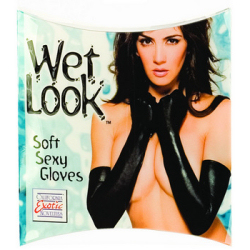
The Wet Look Gloves by  California Exotics are made of a rather shiny material that I would guess is some sort of nylon but is not as shiny as PVC. They are matte on the inside and have some stretch. I’d wipe them clean with a damp cloth if they were dirty. Maybe hand-wash them in the sink but I’m not sure about the machine. The package lists neither care nor material information.

From tip to tip, they measure just under 19.5″. They’re quite long and even the model on the package is wearing them well past her elbows. On this short legged and armed girl, they’re almost ridiculous. I’m must rather see the glove stop right before or after the elbow; it’s just an odd length.

It’s made even odder by the fact that these gloves are intended for folks with thinner arms than myself. They’re snug but comfortable enough over my forearms but become a bit too sausagey, past the elbow. It’s not very attractive. If I slouch the gloves a bit, you do not notice as much, however. At the opening, the gloves have a width 3.75″ when lying flat and unstretched. You can add about another inch to the width if you stretch, but I guess my arm is just a bit too big for these.

Which is a shame because they’re the first gloves to actually fit my hands. You see, I have child hands with short little fingers. Let me explain that, this past winter, I actually wore my 7-year-old sister’s gloves to make a snowman. The hands fit perfectly on these. If you have real-people hands, you’ll probably find these a bit tight, and if you’re a man looking into some accessories, pass the Wet Look Gloves by if you’re not tiny-boned as well.

It’s weird because the fingers really do look pretty short. I’m not sure who these gloves would best fit. A teen girl maybe? I find it really perplexing.

Quality-wise, the seams are all sewn quite well. The tips of the fingers are a little bulky and boxy, however. You can easily see that in the product images where the model shows her fingers. Despite the overall boxyness of the fingers, the material is thin enough to participate in a wide range of activities without having the gloves become an obstacle. For example, I am typing this paragraph with a glove on. It’s a little weird to use my pinky to type, but all of my typos actually come from the other hand. LOL

These are not identical gloves, either. One is specifically for the left hand, while the other is specifically for the right, so they’re a bit more form-fitting than those cheaper types (I’m talking about you, crappy winter gloves that are too thin to keep me warm or dry!).

You could easily stroke a cock with these. And use a toy, if it’s not full of lube. You’ll still be able to feel someone if you’re smacking or spanking them. Need to cut something? These gloves aren’t going to get in the way of scissors or pens. I can easily click on my mouse but it does feel a little weird to hold it. I probably wouldn’t try any needle-and-thread sewing wearing them, but overall, they’re fairly practical.

They’d be a great addition to any cat woman costume, or you could top off a kink formal with the Wet Look Gloves. They’re not so wet-looking that you couldn’t use them in place of regular satin gloves for other costumes or events, either. They’re a great prop for photos, and if you’re playing with any metal objects, the contrast is great. Perfect for scening (mad scientist, anyone?), too.

But the sizing is still pretty weird. So while I can think of many situations in which you’d want to wear the Wet Look Gloves, I can’t think of quite as many that actually allow a person to comfortably do so.


13 Comments